Architecture
Overview
flowchart TB
    internet((Internet))
    subgraph sede["Salandra site"]
        confine["x86 border router<br/>NINUX OpenWrt<br/>10.27.22.1 · 194.28.98.57"]
        subgraph pve["Proxmox VE"]
            ow["OpenWISP CT<br/>10.27.22.18 · 194.28.98.61<br/>controller, RADIUS, ZeroTier VPN,<br/>Babel, router logs, LuCI proxy"]
            jenkins["Jenkins CT<br/>10.27.22.7<br/>firmware build"]
            dns["DNS hidden primary VM<br/>10.27.22.14<br/>BIND, DNSSEC, ACME"]
            mon["Monitoring CT<br/>Prometheus, Grafana"]
            altri["Other services<br/>mail, websites"]
        end
        ap["Site APs and routers<br/>(cable and 802.11s mesh)"]
    end
    sec["Public DNS secondaries<br/>(VPS)"]
    remoti["Remote nodes<br/>(homes, associations)"]
    tel["Android app"]

    internet --- confine
    confine --- pve
    confine --- ap
    dns -. "WireGuard: AXFR/IXFR" .- sec
    remoti -. "ZeroTier VPN + Babel" .- ow
    ap -. "802.11s mesh + Babel" .- remoti
    jenkins -- "firmware images (API)" --> ow
    dns -- "certificates (rsync)" --> ow
tel -- "REST API (HTTPS)" --> ow- Border router: an x86 box with NINUX OpenWrt. It goes to the Internet and
carries the public /29
194.28.98.56/29, routed through a PPTP tunnel to the provider. The rest of the site is on the management LAN10.27.22.0/24. - Proxmox VE: a single host, with one container (LXC) or VM per service. Every service is rebuilt by an Ansible playbook.
- OpenWISP manages all routers: configuration, monitoring, VPN, RADIUS authentication of the hotspots, firmware upgrades.
- Jenkins builds the NINUX OpenWrt firmware and uploads it to OpenWISP.
- DNS: the primary is hidden in the LAN, the public secondaries receive the zones through a WireGuard tunnel. The same server issues the wildcard certificates and copies them to the containers that use them.
The router network
| Network | Addresses | Use |
|---|---|---|
| Site management LAN | 10.27.22.0/24 |
servers, APs and routers of the site |
| Node LANs | one /24 per node inside 10.27.0.0/16 |
the clients of each node |
| ZeroTier VPN | 10.27.255.0/24 (server .1) |
connects remote nodes to the server and to each other |
| 802.11s mesh | br-mesh, SAE encrypted |
radio links between nearby nodes |
| Hotspot | captive portal network (uspot) | free Wi-Fi with RADIUS login |
Routing between nodes is done by Babel (BIRD): every node announces its LAN
and learns the others. Every link has a cost, computed by Babel from its
rxcost; the metric of a route is the sum of the costs of the links it
crosses, and the lowest one wins.
| Link | rxcost |
Cost |
|---|---|---|
| Cable | 96 | fixed |
| Radio (802.11s mesh) | 256 | from 256 up: it grows with packet loss (ETX) |
| ZeroTier VPN | 600 | fixed |
So cable always beats radio, and a good radio link beats the VPN; a badly degraded radio link can cost more than 600, and then Babel goes through the VPN. The default route never goes through Babel: every node reaches the Internet through its own connection, and nodes without one learn it from their mesh neighbours via OSPF.
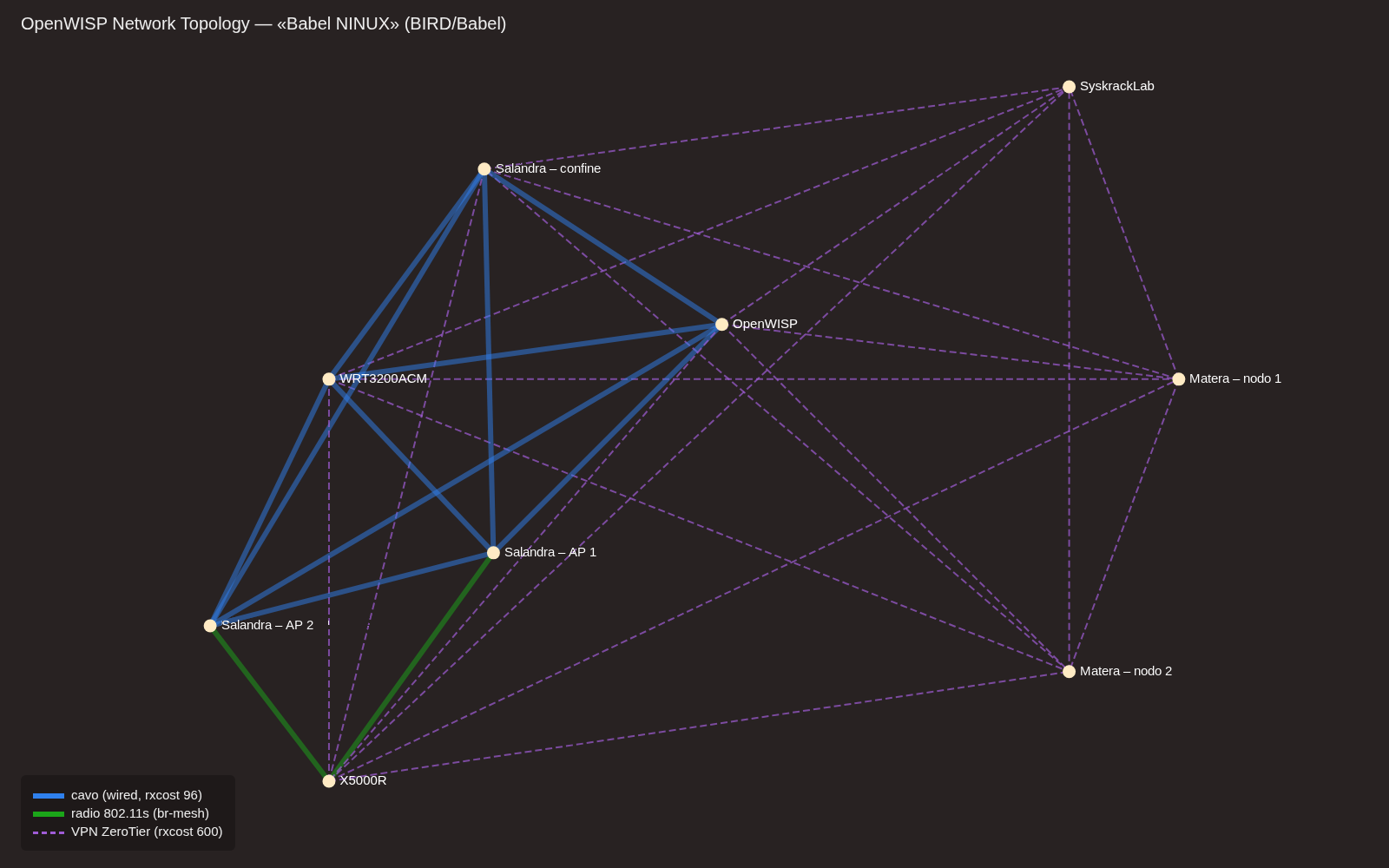
The "Babel NINUX" topology in OpenWISP: the site on the left (cable and radio), the remote sites on the right, reached through the VPN.
Details (costs, filters, topology script) are in the openwisp2 README, section BIRD / Babel.
DNS names
| Name | Points to | Use |
|---|---|---|
openwisp.ninux-nnxx.it |
OpenWISP (194.28.98.61) |
admin, API, router agent |
wifi.ninux-nnxx.it |
OpenWISP | hotspot login pages |
zerotier.ninux-nnxx.it |
CNAME of openwisp | ZeroTier controller reference |
*.luci.ninux-nnxx.it |
CNAME of openwisp | LuCI proxy, one host per router |
gw.ninux-nnxx.it |
border router (194.28.98.57) |
logs and management of the border router |
dyn.ninux-nnxx.it |
dynamic zone | DDNS of routers with a changing IP |
Main flows
- A new router boots with the NINUX firmware, which contains the OpenWISP
address and the organization secret. The
openwisp-configagent registers by itself, receives the templates (Babel, mesh, VPN…) and joins the ZeroTier VPN. - OpenWISP monitoring checks every router (ping, resources, Wi-Fi clients, traffic) and sends notifications when something goes wrong.
- Router logs (syslog and netconsole) reach the OpenWISP server and can be read on the device page.
- New firmware is built by Jenkins, uploaded to the OpenWISP firmware upgrader and installed on the routers from there.
- Hotspot users sign up on the Wi-Fi page (also with Google) and are authenticated by FreeRADIUS through OpenWISP.